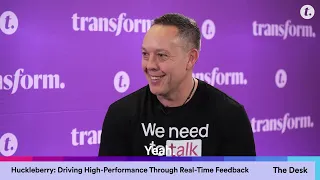
A founder essay on why traditional 360 feedback fails, why feedback is still critical, and how it works when it has somewhere useful to go: a coach grounded in the people who actually know you.
Author: Aaron Ward, CEO and Co-founder
In the Old West, when someone said “I am your Huckleberry,” they were declaring themselves the right person for the job. No resume. No credentials check. Just a reputation built on what people knew about how you showed up.
We have spent the next 150 years making it harder to prove that.
I spent a decade in the feedback business. As CEO of AskNicely, I helped build what became a market leader in customer feedback for service businesses. Companies that rely on frontline staff to make every customer experience count. We enabled millions of real-time customer conversations.
It worked. Recognition changed behavior. Retention improved. Work became more meaningful for people who had previously been invisible.
So naturally, we thought: if this works for customer feedback, let us apply the same approach internally. Help our own people grow through feedback from their peers.
We tried. Multiple times. Different 360 tools, different approaches, different consultants with different frameworks.
It failed. Every time.
Response rates were poor. Everyone hated the process. The output was either so sanitized it was useless or so blunt it damaged people. Our high-performers resented the generic output. Our struggling performers felt attacked rather than supported. And HR spent weeks chasing responses rather than actually helping anyone develop.
Here I was, running a feedback company, unable to make feedback work for my own team.
That failure haunted me. And eventually, it became the founding insight for Huckleberry.
The part that took us longer to understand: feedback was not the problem. What we did with it was the problem.
Let me be direct about what is wrong with the standard approach. These are not minor annoyances. They are structural failures baked into the design.
Traditional 360 feedback is reserved for leaders and “high potentials.” It is triggered by HR cycles, not individual need. It depends on manager permission and organizational rollout. Early and mid-career professionals are excluded. Ambitious individuals cannot proactively seek feedback. Growth is rationed instead of accessible.
If feedback really mattered, everyone would have access to it, all the time.
Ask anyone what their last 360 report felt like. Vague. Over-sanitized. Politically coded. Hard to act on. Most outputs consist of ratings, averages, and safe language stripped of meaning.
People do not grow from spider charts. They grow from specific examples, real moments, and human language.
Traditional 360s require long written surveys, dozens of repetitive questions, and significant time from busy colleagues. Response rates drop. People rush their answers. Quality collapses. According to Gartner, the average manager spends 210 hours a year on performance reviews. That is insane for what comes out the other end.
Traditional 360 feedback lives inside HR systems, locked behind permissions. It disappears when you change jobs. It cannot be reused, shared, or built upon.
Your career spans companies. Your feedback should too.
This is the one most companies miss.
Even when the survey design is good, even when responses are high, even when the report is well-written, the system fails at the last mile. You read your report. You feel mildly bad or mildly validated. Then you go back to work.
There is no one in your corner who knows what is going on, who you are, what you are trying to become, and what to do about it on Tuesday afternoon when the hard conversation is six minutes away.
Feedback without a coach attached is just data.
This is where we landed.
The reason 360 has failed for 30 years is not that feedback is unimportant. Feedback is one of the highest-leverage inputs to growth that exists. The reason 360 has failed is that the output had nowhere to go.
We built the place for it to go.
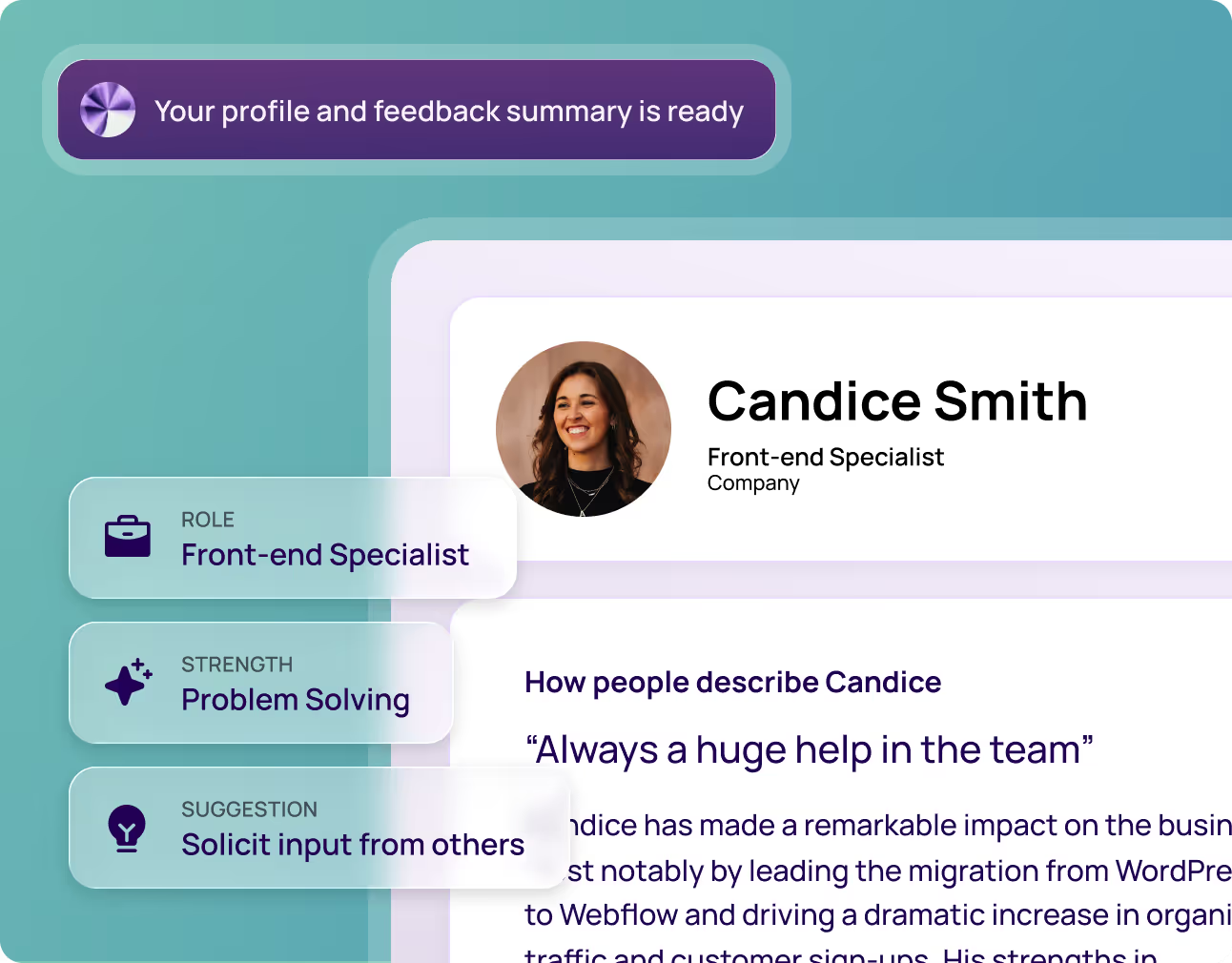
A professional AI coach for everyone, voice-first, available the moment the hard conversation is about to happen. Grounded in real feedback from the real people you actually work with, so the coach knows what is going on for you.
Without the feedback, the coach is generic. Without the coach, the feedback is data. The combination is what makes the system work.
When peer feedback flows into an AI coach instead of a PDF report, two things happen.
The first is that the feedback gets used. Instead of sitting in your inbox, it becomes context for every conversation you have with your coach. You bring a 1:1 prep, and the coach knows where your colleagues see your strengths. You bring a hard decision, and the coach knows what you have heard about how you handle ambiguity. You bring a career conversation, and the coach knows what people who have worked with you for two years say about your trajectory.
The second is that you do not have to read the report. The hardest part of feedback was never the data. It was the cognitive load of figuring out what to do with it. The coach carries that for you and surfaces it when it is relevant.
That is the model we have built. Real feedback from real colleagues, attached to a real coach who knows what to do with it.
If you are an HR leader who has been apologizing for your 360 process, who knows there has to be a better way that gives your people something that actually helps them grow, Huckleberry is for you.
If you are a professional who is tired of feedback reports that go nowhere, who wants someone in your corner the moment the hard conversation is about to happen, Huckleberry is for you.
I am your Huckleberry.
Love your work,
Aaron
The hardest part of coaching is context. A generic coach gives you generic advice. A coach who knows what your colleagues actually think of you, what your team has been working on, and how you have handled the last six months gives you something useful. Real feedback from real people is the input that makes a coach accurate.
Yes. Voice-based feedback from real colleagues is one of the things that makes Huckleberry different from a generic AI assistant. The coach uses peer feedback as context. You can see your own feedback if you want to, but most users never read a “report.” They just notice the coaching has become more accurate.
Huckleberry started as a voice-first 360 feedback platform. We raised our pre-seed in 2025 with that focus. By the time we launched publicly in April 2026, we had learned that the bigger gap was not better feedback. It was a coach to do something useful with feedback once you had it. Feedback became the foundation. The coach became the product.
Cost and coverage. Human coaching at $300 an hour reaches the executive 5%. AI coaching at $20 a seat reaches everyone. The coach is available the moment the hard conversation is happening, not three weeks later in a session that has been booked.
GROW, SBI, Radical Candor, and Situational Leadership. The same frameworks used in MBA leadership programs and by professional executive coaches. The coach selects the right framework for the moment.
Yes. Architecturally private. Individual sessions are never accessible to managers, HR, or admins. No compliance API. No eDiscovery path. Audio is processed in real time and never stored. Your data is yours.

.png)
.png)