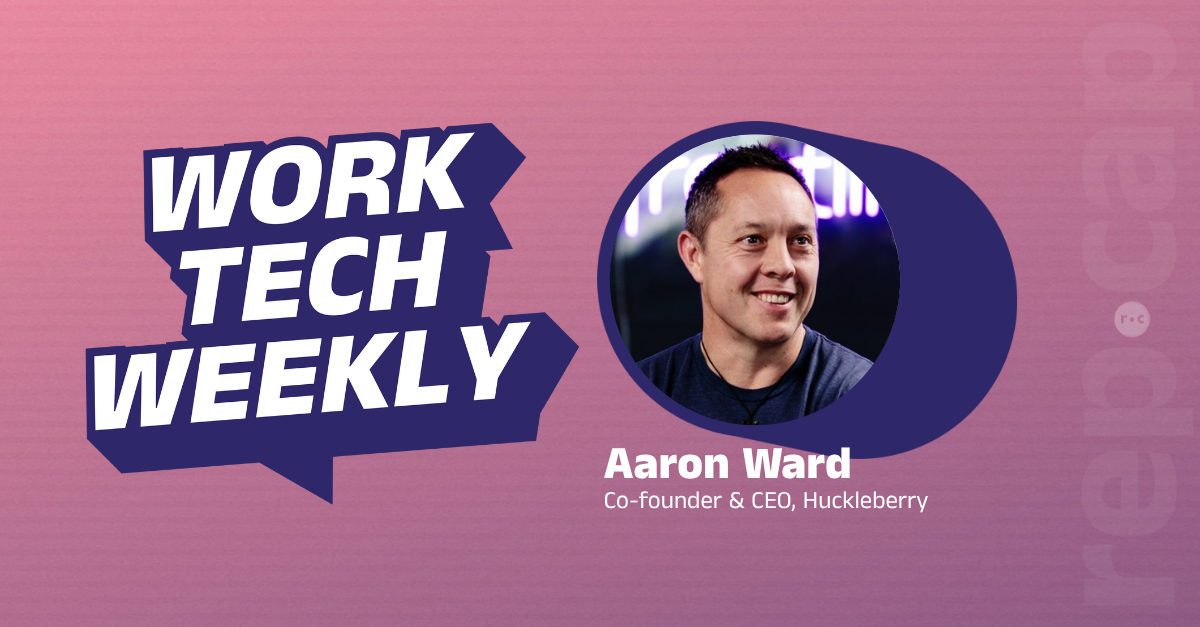
Aaron Ward sits down with Samara Jaffe at Transform to launch Huckleberry. The 10-minute interview includes a live product demo and the founder's origin story.
By the Huckleberry team
Aaron Ward, co-founder & CEO of Huckleberry, in conversation with Samara Jaffe on The Desk Live at Transform 2026. Recorded the morning of our public launch, March 23.
A 10-minute interview, a live product demo, and the case for why coaching shouldn't be reserved for the C-suite.
This morning at the Transform conference, Aaron announced Huckleberry's public launch. About an hour later, he sat down with Samara Jaffe on The Desk Live to talk about why we built it and what it actually does. The full conversation is embedded above. If you've got 10 minutes, watch it. If you don't, here's the recap.
Huckleberry is a professional AI coach for everyone, sitting on your phone. You call in, you talk through whatever's on your mind, and you get someone who asks good questions and helps you find your own answers.
Aaron's framing in the interview:
"Could be a tough conversation you're dreading, a team dynamic that's messy, a decision you're wrestling with, whatever's real for you right now."
It's $20 per month. The free tier gives you 30 minutes every month, refreshed automatically.
Coaching is the highest-leverage form of professional development. Every senior leader who's had a coach will tell you it changed how they show up at work. But coaching has always been priced and structured for the top of the org chart only.
Aaron put it plainly:
"Executive coaching is great, but the problem with executive coaching is it's only for executives. We don't all have $500 an hour."
That's the gap Huckleberry fills. Most knowledge workers will go their entire careers without a single professional conversation about the things that actually weigh on them at work. Coaching would help. The price tag and the booking friction just put it out of reach.
A $20-a-month app on your phone changes the unit economics. Will it match an expert human coach hour for hour? No. But it gets coaching into the hands of millions of people who would otherwise never have access to it, in the moment they actually need it. As Aaron said in the interview: "Unlike your executive coach who's around maybe once a month, Huckleberry is there for you at 2 a.m."
Aaron's previous company, Ask Nicely, was a customer feedback platform for the service sector. The big lesson from that decade:
"If we can catch people in the act of doing things right, they are more likely to come back tomorrow and do it all over again."
Feedback and recognition change how people feel about their work. Once you've seen that play out for frontline service workers, you can't unsee the same gap for everyone else.
The personal version of the story is sharper. About seven years ago, mid-flight at Ask Nicely, Aaron hired his own executive CEO coach. He described the impact:
"The effect for me personally was transformational. I became a better leader and a better colleague, but I also became a better husband and a better father. All I needed to be was a 40-something year old CEO of a venture-backed startup. And that's just outrageous. Where was this back in my 20s?"
The whole pitch sits in that last sentence. Coaching shouldn't be a reward for making it to the top. It should be the thing that helps you get there.
Samara asked the question every employee will ask before opening the app at work: what does my company see? Aaron's answer, captured live during the demo:
"Everything you tell me stays between us. Your company can see you're using the tool, but they never see what we talk about or your notes. It's yours alone."
This is non-negotiable in our design. If Huckleberry is going to be the place where you actually work through hard things, it has to be a place you trust. Company visibility is limited to engagement signals (who's using it, how often). It never extends to content.
There are two ways into Huckleberry. Individuals can sign up at gethuckleberry.com and start with the free tier. Companies can adopt it across a team or whole org.
When a company adopts Huckleberry, two things change. First, it connects to your HRIS and employee handbook. Now Huckleberry knows your teammates and respects your company's mission and policies. Coaching gets sharper because the context is real.
Second, HR gets governance. Engagement signals and policy alignment, all without breaking the privacy promise to employees.
This is the bottom-up route. Employees use it because it helps them. Companies adopt it because their people are already there.
The video at the top of this post has the full 10-minute conversation, including the live demo where Aaron called Huckleberry on stage and got real coaching feedback in front of the camera. The demo is worth watching on its own.
If you want to see what Huckleberry feels like for yourself, head to gethuckleberry.com. Thirty minutes free every month, no credit card needed.

.png)
.png)