I got an executive coach at 40, and it changed my career. Most professionals never get one. Here's why we're building the coach I wish I had at 25.
.png)
By Aaron Ward, CEO and Co-founder of Huckleberry
Last updated: 2026-05-06
About seven years ago, I was running AskNicely, my last company. The business was growing fast. Honestly, it was growing faster than I was. I needed to upgrade myself to keep justifying the seat I was sitting in as CEO. So I hired an executive coach.
What happened next changed the rest of my career, and I do not say that as a marketing line. I became a better leader. I became a better colleague. I also became a better husband and a better father. One coach. A few months. The whole thing.
What I needed, to qualify for that coach, was to be a 40-something CEO of a venture-backed startup. That was the prerequisite. And that is outrageous.
Where was that coach when I was 25? When I was a first-time manager screwing up team conversations I did not know I was screwing up? When I was trying to figure out my next career move from books and peers and a vague sense that someone, somewhere, must know what they were doing? Coaching was not there because the cost meant it was not going to be.
The math is simple and brutal. Human executive coaching has run at hundreds of dollars an hour for as long as anyone reading this has been working. The companies that pay for it pay for the senior layer. Below that line, you got a course library, a manager whose coaching skills were luck of the draw, and now ChatGPT. The ICF research puts a number on it: only 27% of organizations make coaching accessible to all employees. The other 73% draw the line where it has always been drawn.
Call it the lucky 5%. Call it 10%. The number depends on how you draw the line, but the shape is unambiguous: the people who already had the most career runway got the most career help. The other 95% have been figuring it out alone.
I sat in the 95% myself for years before that changed. The experience of finally getting the kind of help that should have been there from the start is what made me start building Huckleberry.
We started Huckleberry by making feedback easy. Voice-based 360 feedback that replaced the surveys nobody filled in honestly. Feedback is the foundation of any real coaching relationship. You cannot coach what you cannot see, and most professionals have no honest mirror at work.
With Coach, we are accelerating that vision. Voice AI applies real coaching frameworks to the situation you are actually in, with the feedback layer underneath. The coach knows how you land, because the feedback feeds the conversation. Feedback alone has limits. Feedback inside coaching produces change.
Coach is a different category from traditional coaching, and from most of what is being marketed as "AI coaching" today.
The fix to the access problem is not spending more on traditional coaching. Doubling that budget reaches maybe ten more executives. It does nothing for the layer below. Scaling human coaching has always been the constraint on access, which is precisely why it has never been the answer.
The fix is a different category. Coaching that is purpose-built around what coaching actually does, at a price and accessibility that traditional human coaching can never match. Structured conversations, applied frameworks, persistent memory of the person being coached, and the privacy to be honest.
Most products marketed as "AI coaching" today fall short of that bar. The category is littered with tip-of-the-day apps and text chatbots. Some companies have rebranded survey tools as feedback platforms and called it coaching. They do not apply real coaching methodology. Coaching only happens when methodology meets a real situation in real time, and the rest is just content.
We believe every professional should have access to a real coach. Up to now, that has been a privilege of the few. The technology to change it is finally here.
The old way was scheduled coaching for the senior layer, courses for everyone else. A $500-an-hour coach on the calendar, once a month, if you were one of the people who got one.
The new way is voice in your pocket, with frameworks built in. Available the moment a conversation matters. Three minutes if that is what you have. Fifteen if you need it. $20 a month for individuals, with a free tier so you can start before deciding.
What changed is the technology, and specifically what it makes possible. Voice AI is now good enough to hold a real coaching conversation. AI reasoning can apply established coaching frameworks like GROW, SBI, and Radical Candor to a specific situation in real time. The economics have moved from $500 an hour for one person to $20 a month for everyone in the org. None of that was true five years ago.
The outcomes look different at each level, but they reinforce each other.
For a manager: The hard feedback lands because you rehearsed it. You catch the team member who was going to leave, in time to keep them. Every person on your team is getting a real development conversation, including the quiet ones who never ask. You become the manager people stay to work for.
For an HR leader: The metrics you are measured on finally move in the right direction. Engagement scores rise where they were lowest. The same exit themes that have shown up under the same managers for years stop showing up. Manager variance compresses, and the employee experience stops being a lottery. You give every person in the org something real, without doubling the L&D budget to do it.
For an exec or founder: The org develops itself. The bench you were counting on actually builds. Hard conversations get caught at the manager layer, instead of escalating up to you. The coaching that built your career is no longer the privilege of a few. You stop being the coaching multiplier of last resort, because every layer of the org has its own coaching support.
I am building Huckleberry as the product I wish I had at 25. The coach I needed when I had no idea what I was doing as a first-time manager. The coach a million people in those same shoes need right now.
The mission is to coach the un-coached. To make the support that built me, and the support that builds anyone fortunate enough to get it, available to everyone whose career is still being built. Not the 5% with budget-line access. The 95% who have been figuring it out alone.
If you have ever sat through a 1:1 you did not know how to handle, or walked into a hard conversation hoping it would go well, this is for you.
We don't all have $500 an hour. So we built it for $20 a month, with a free tier so you can start without giving us anything but your time.
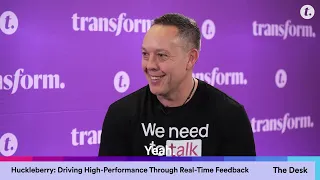
Start for free. 30 minutes a month, no credit card. Huckleberry launched publicly at Transform 2026 and is live now.

.png)
.png)