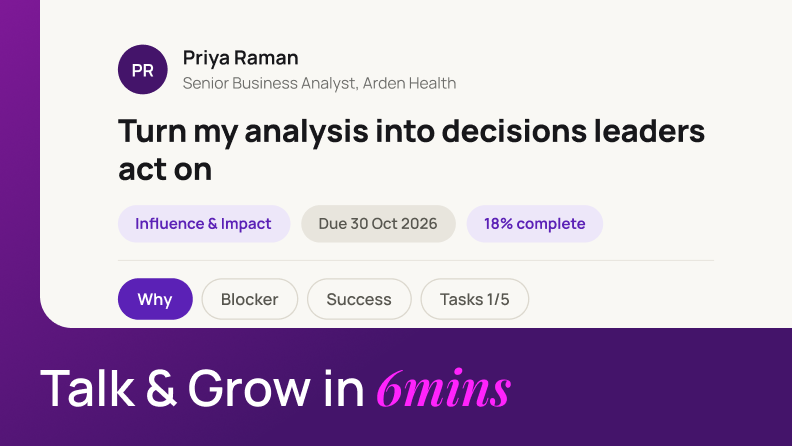
Why AI coaching with persistent memory and company context beats one-off sessions, what a coach should remember, and how to keep that context private.
%20(1).png)
A chatbot can remember that you like short answers. It has no idea your company defines a good team leader differently from the internet, or that you promised yourself you'd finally have that conversation with your direct report this week.
That gap decides whether AI coaching changes how people work or becomes one more tool they tried once. Coaching compounds when each session builds on the last one. Without memory and context, every session starts close to zero.
Picture a manager opening a coaching session ten minutes before a tough 1:1. A good coach will ask questions first, and it should. The difference is where those questions go. Without memory, the time goes on background the manager has explained before: who this person is, what happened last month, what they already tried. With memory, the coach can move straight to what helps now, like the outcome they want and how they'll open the conversation.
Human coaching has a version of this problem too. A good coach remembers your goals, but you might only see them every few weeks, and the hard moments tend to land in between.
General chat tools now remember some things about you, like your role or the tone you prefer. That's useful, but it isn't coaching memory. Coaching has to hold the thread of your development: what you're working on, what you said you'd do, and how it went.
Useful context comes in layers, and each one makes the next conversation shorter and sharper.
A coach doesn't need a transcript of everything you've ever said. It needs the parts that move your development forward.
Here's what context looks like across one week. On Monday, a new manager preps a feedback conversation and commits to naming one specific behavior. On Thursday, the coach asks how it went. It already knows who was involved and what the manager committed to, so the conversation goes straight to what happened and what to try next.
That follow-up is the part people rarely get from a workshop or a one-off chat, and it's how good intentions turn into habits. Over a few months, the coach can also notice patterns, like a conversation someone keeps putting off, and raise it while there's still time to act.
This matters for leaders twice over. You get a coach that knows your context, and every person you lead gets one too, so development keeps moving when your calendar is full.
The more a coach knows, the more people need to trust where that knowledge goes. Two design choices matter most.
Company context flows in, but sessions don't flow out. Your handbook and competency model shape the coaching. What someone says in a session never goes back to their manager or HR, who see aggregate usage and engagement data only.
The person owns their history. Their growth plans and feedback belong to them and go with them if they change jobs. Company-provided context, like team profiles and policies, is removed when they leave.
For more on why this matters, see why generic AI assistants aren't safe for employee coaching.
If you're weighing a home-built option, should you build your own AI coach or buy one? covers the trade-offs.
With Huckleberry, you give every manager and every person they lead a voice-first AI coach that builds on each session. On a team plan, you load your company context once, from your handbook and competency model to leadership messages on current priorities. Each person's coach starts every session already prepped with their last conversation, open commitments, fresh feedback from colleagues, and what's on their calendar this week. See how Huckleberry works for HR leaders.
Q: What is persistent memory in AI coaching?
A: It's the coach's ability to carry context from one session to the next, including your goals and the commitments you made. Each conversation picks up where the last one ended, and the coach can follow up on what you said you'd do.
Q: Is ChatGPT's memory enough for coaching?
A: Chat memory can hold facts and preferences about you. Coaching also needs your company's context, follow-up on commitments, feedback from colleagues, and privacy that keeps sessions away from admin tools.
Q: Can HR see what an AI coach remembers about an employee?
A: With Huckleberry, no. Session content isn't available to anyone at the company. HR sees aggregate usage and engagement data only.
The best coaching conversation is the one that picks up where the last one left off.
Book a demo to see how Huckleberry puts your company's context to work.

%2520(1).png)