Most AI coaching asks you to take quality on faith. How Huckleberry scores every session against a rubric informed by the ICF Core Competencies.
It is the right question to ask of any AI coach. Most tools in this category are a chat window with a friendly tone, and they ask you to take quality on faith. We think quality should be measured. So we built Huckleberry to score itself against the one professional standard that defines what good coaching looks like.
The International Coaching Federation publishes the Core Competencies, the closest thing the profession has to a behaviorally specific definition of coaching quality. They describe what a skilled coach actually does in a session: agree the focus, build trust, stay present, listen for what matters, draw out the client's own insight, and leave the client owning the next step.
What makes them useful to us is that they translate into observable behaviors. One open question at a time. The client's own language rather than the coach's. The insight comes from the client. The commitment belongs to the client. Behaviors like these are checkable, which means they can be scored.
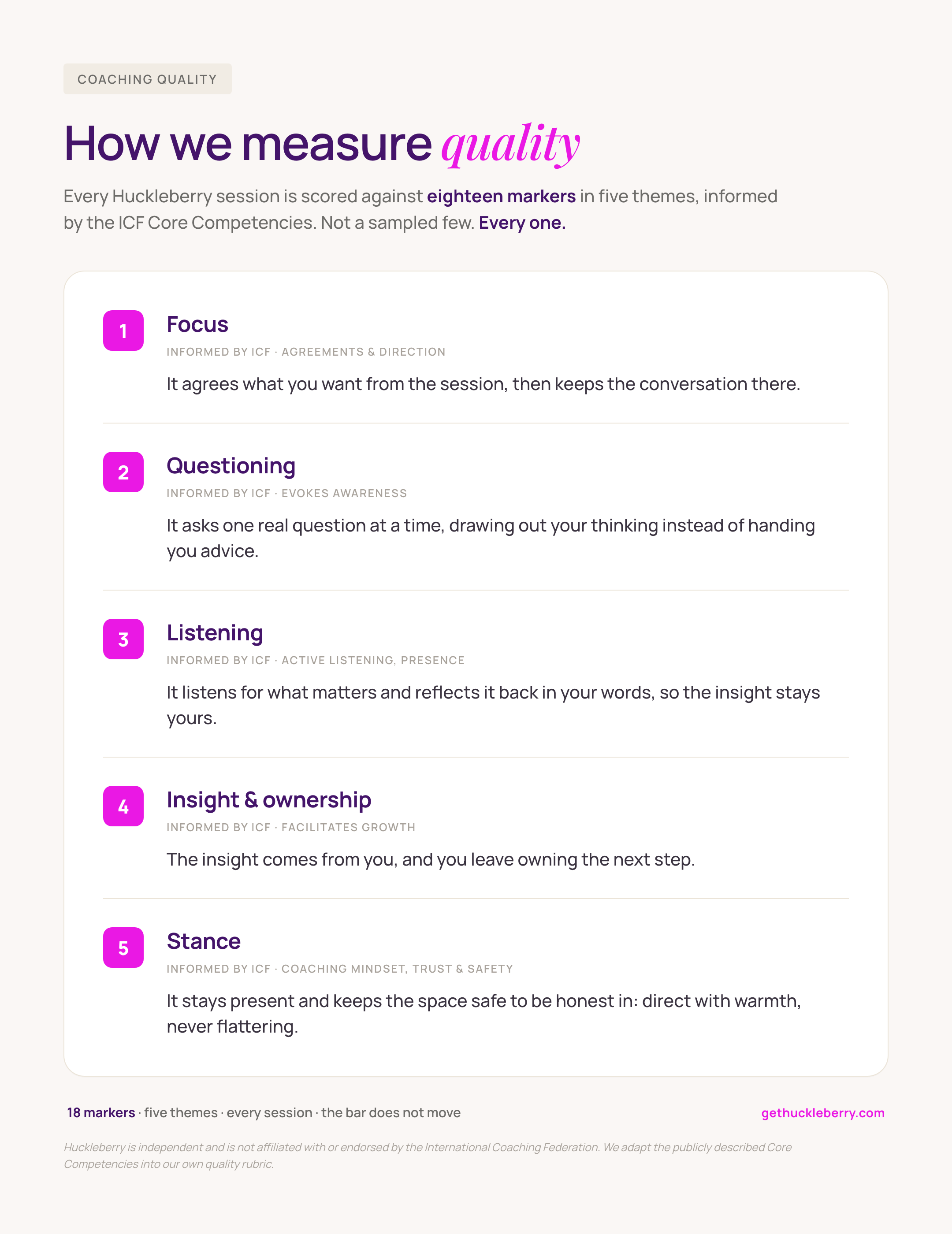
We adapted those competencies, in our own words, into a set of eighteen Huckleberry Markers, grouped into five themes: focus, questioning, listening, insight and ownership, and stance. Every coaching session is scored against that rubric, informed by the ICF Core Competencies. Not a sampled few sessions. Every one.
That is a bar a human coach is rarely held to. A professional coach is formally assessed once every few years, on one or two recorded sessions. Huckleberry checks every conversation, every time. When we change how the coach works, we can see the before and after on the same set of transcripts. Quality stops being a feeling and becomes a number we watch.
Classic coaching orthodoxy is strictly non-directive. The coach never advises, never role-plays, never names a pattern. That works for an hour-long executive session. It does not work for a manager who has twelve minutes before a hard conversation and wants a thought partner with a point of view.
So we made a deliberate choice. Huckleberry is directive with warmth. We diagnose before we prescribe, and the directiveness is earned through good questions first. Role-play is a feature, not a violation. Patterns are offered as offers, with a "does that land?", rather than handed down as verdicts. Frameworks like GROW, SBI, and Situational Leadership sit in the toolkit. The bar that decides whether a conversation was good coaching is informed by the ICF Core Competencies. The toolkit can grow. The bar does not move.
Enterprise teams can load their own competency model, lexicon, and ways of working, so the coach speaks the way your company speaks. What never changes is the quality bar. You customize the charter. You do not customize what makes it coaching.
Coaching quality is usually sold on vibes: a logo, a methodology name, a confident founder. We would rather show you the scoreboard. A coach measured against a professional standard on every session is a coach you can trust at scale, for everyone you lead, not only the few who used to get one.
Huckleberry is independent and is not affiliated with or endorsed by the International Coaching Federation. We adapt the publicly described Core Competencies into our own quality rubric.

%20(1).png)
%2520(1).png)