A working coach was skeptical of AI coaching. Real stories on trust, safety, and what changed his mind about how Huckleberry deepens human coaching.
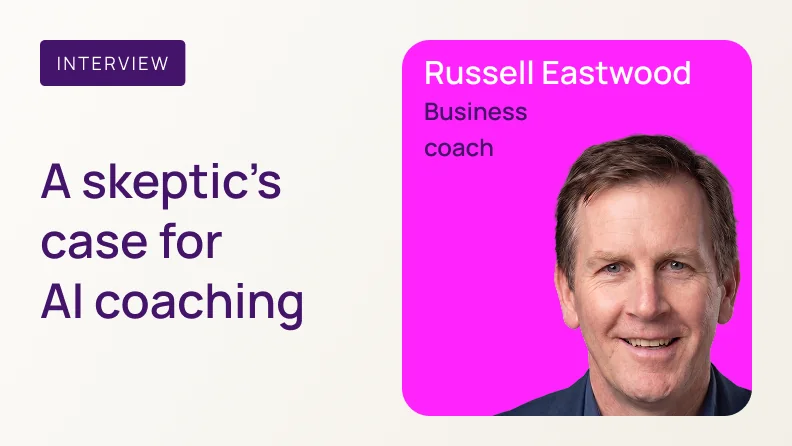
As told to Marcus Hoefliger, co-founder of Huckleberry. Russell Eastwood is a business coach and director of Eastwood & Co.
When I first heard about Huckleberry, my gut said no. I've built my practice on the belief that real coaching changes people's lives. An AI doing it felt like a threat to everything I'd spent years building. I imagine that's where a lot of coaches are right now. So I want to reflect from that place.
The question I get from skeptical clients is: what if the AI gives people the wrong advice?
Here's what I've found. Huckleberry doesn't give advice. It does what every coach spends their career practicing: it asks questions to surface the individual's own answers. No steering or agenda. No read of the room it brought in from its own bad morning.
I call myself my clients' unconditional champion. That's the whole job is to be entirely for them, without judgment, without an agenda of my own. Huckleberry does that with a consistency that, frankly, beats me hands down. I'm human. I have off days. I sometimes steer slightly when I'm trying not to. Huckleberry doesn't.
That's not a small thing. Pure coaching, done consistently, creates safety. Safety is the mechanism everything else runs on. When someone feels genuinely safe, they become more vulnerable. When they're more vulnerable, they open up to real development. That chain is what coaching is trying to create, and Huckleberry starts it fast, every time, without the risk of an off-day on either side of the conversation.
The clearest evidence I have came from a session on the same morning I spoke with Marcus for this piece.
I've been working with a school principal for a couple of years. She runs her school the way a CEO runs a company, and she's meant to be the head of learning on top of all of it. We've had good sessions over the years. But recently we've been working at a level I hadn't reached with her before. The depth of her reflection when she arrives and where we're able to go together because of how she's showing up after using Huckleberry between our sessions.
That morning, we were putting icing on a cake I hadn't known existed. The best coaching I've ever done. And it happened because she'd been using Huckleberry. She arrives differently now. So I can take her somewhere different.
The conversation I have most often with senior leaders isn't about their own development. It's about the people below them who aren't getting developed, and their own inability to fix it. Not from lack of intention, but from lack of time.
I recently looked at DiSC profiles for two new hires at a client's company. Both high Ds. Strong personalities who'd either thrive or create friction depending on the support they got early. My client knew that. He also didn't have the hours. "We can't coach everyone," he said, "because they're further down the pecking order."
That's the gap AI coaching closes. The high-potential hire too far down the org to get a coach's attention. The first-time manager walking into situations nobody prepared them for. The high performer who wants to grow and will go looking elsewhere if the organization can't give them that. These are the people who'll use it hardest and benefit the most.
No. And I say that as someone who genuinely wondered.
Think about how human coaching actually works. A session every few weeks. The real moments, the difficult conversation at 8am, the decision at midnight, the idea in the shower, happen between those sessions, without any support. AI coaching is there for those moments. It's the rehearsal space before the hard conversation. The thought partner when something comes up and there's no time to wait for the next scheduled session.
What that does for a human coaching relationship is unlock it. Clients arrive having already reflected and shifted. Instead of spending the session catching up to where they are, we start from there. I was one of those coaches who worried about what AI would do to my work. What I found is the opposite: the clients using Huckleberry between our sessions are the ones I coach at the highest level.
The AI handles the 23 hours it isn't possible for me to be there. So when I am, we go further than we ever could before.
Read next: Russell's point about consistency is something we measure. See how Huckleberry scores every session against a rubric informed by the ICF Core Competencies.
About Russell Eastwood
Russell is the director of Eastwood & Co, a business coaching and mentoring practice based on Auckland's North Shore. He works with leaders across New Zealand on performance, difficult conversations, and building stronger teams.
Learn more about Huckleberry.

%20(1).png)
%2520(1).png)